CLIENT COUNTERBELL (INVENTED BRAND) · APP LAUNCH · 16:9, 9:16, LOGO, 6 TEMPLATES, STEMS · 1:34 · 2026
App launch video forCounterbell (concept)
A 94-second launch video for a booking app: one shop owner's day, her counter built in Blender, the real interface lit inside the screens.
Counterbell is an invented product and brand, made for this portfolio. Dana, her bike shop, her customers and every figure in the app are fictitious, and the interface was built for this video. What was generated is listed at the end.
counterbell-launch-16x9.mp4 · 1920×1080 · 24 fps · 1:34 · −13.9 LUFS integrated, measured on the delivered file
The brief
We're launching Counterbell: it answers the phone for shops that have no front desk. When a customer calls and nobody picks up, it texts them back, offers times that fit the job and takes a deposit; it sends the reminder, moves the booking with one reply and collects the rest at pickup. We need a launch video of about 90 seconds (16:9) that explains it to someone who has never heard of it, through one shop owner and her day; a vertical cut of about 27 seconds with the app inside a phone and burned-in captions; the logo animated on its own, with a transparent version our team can drop on any background; a kit of three animated templates for social (feature announcement, a figure or a quote, and "now available"); and the sound as separate stems. English only. We want craft you can see: real 3D objects with real light, one consistent world, the interface readable on screen.
Process
Write the idea before asking for anything.
The script came first, then the central idea on one page: what is live action, what is 3D, what is interface and what is drawn, the look, the sound and every shot. The list of materials was written from that page, before a single file came in. The piece in one sentence: Dana fixes bikes with her hands full while her phone buzzes on the bench; a tap on a brass counter bell, and her counter becomes the stage for the product.
THE PIECE IN ONE SENTENCE
Dana fixes bikes with her hands full while her phone buzzes on the bench. A tap on a brass counter bell, and her counter becomes the stage for the product: the same wooden bench, the same light, one phone, one laptop and the bell, all in 3D, with the real interface lit inside their screens.
FIVE MOMENTS OF CRAFT
The brass bell rings once, and the 2D mark takes its exact place and size.
The two times on offer lift off Luis's phone toward the camera.
His booking flies from the phone into Dana's calendar on the laptop.
The camera travels into the laptop until the web app fills the frame.
Three shop fronts in one green line; the drawing fades into the real screens.
Cast one voice for the brand.
A narrator for the brand, calm and plain-spoken, cast over three measured rounds. Each section was voiced on its own so the rhythm changes from one to the next. Every word was timed by forced alignment, 241 in the launch and 58 in the vertical cut, and 273 of those 299 were also checked against the audio's own onsets; every title and caption lands within one frame of its word.
Build the product, then record it.
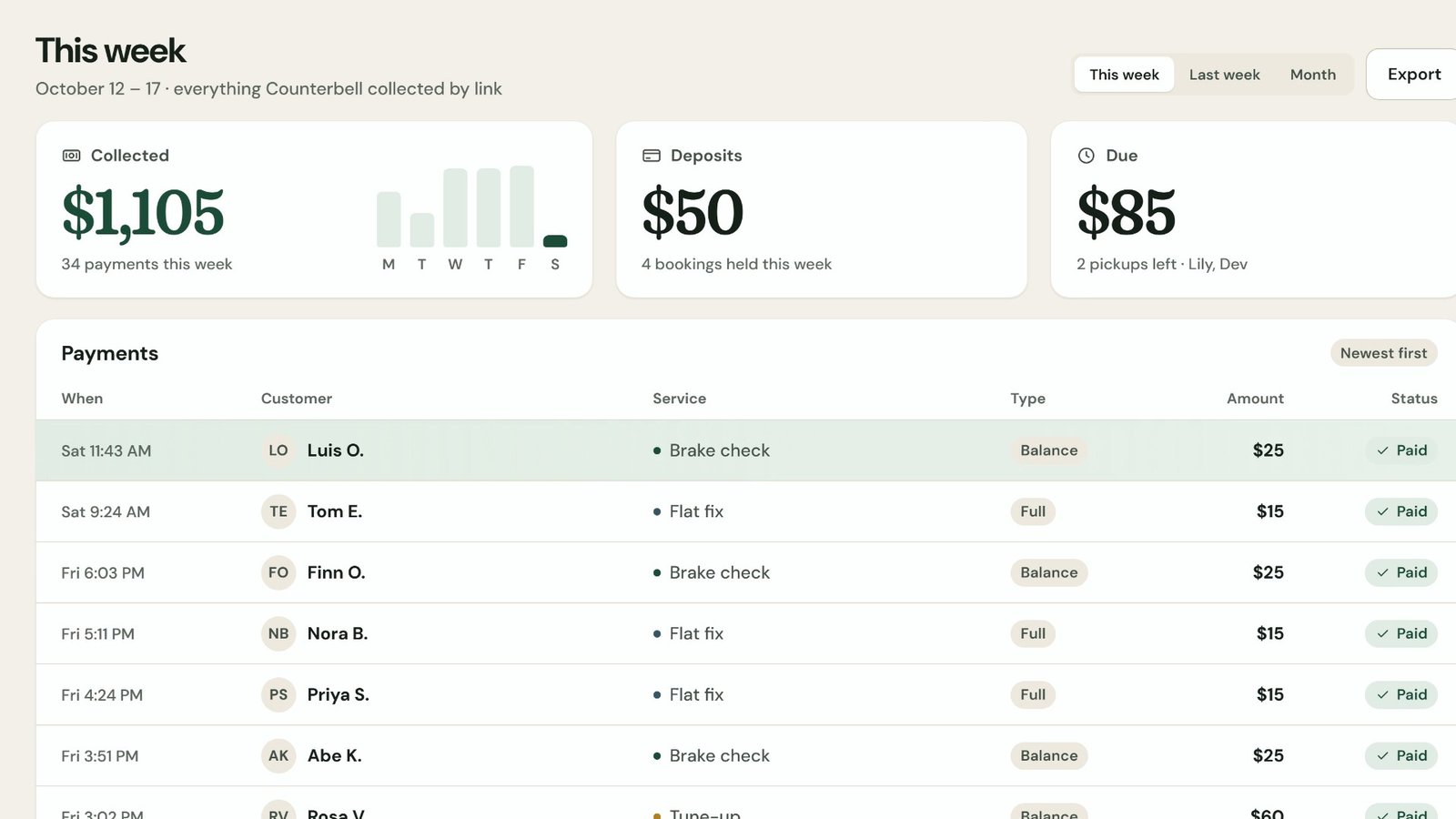
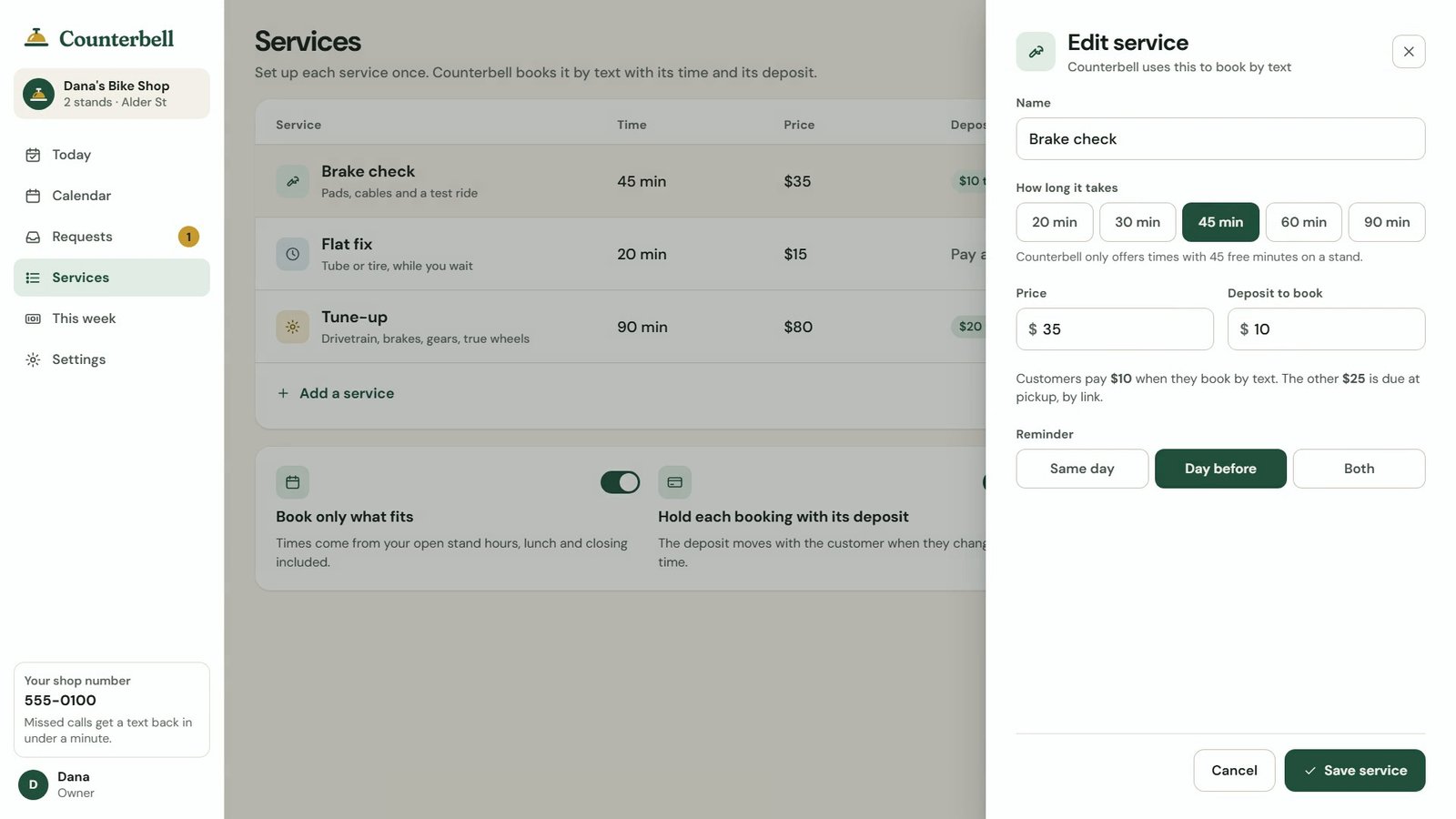
Counterbell runs nowhere else. Every screen was built as a working web page in the brand's own system, one palette, two typefaces and one set of motion curves, and recorded frame by frame on a virtual clock, each tap and message on the word that names it.
Build the counter once, in Blender.
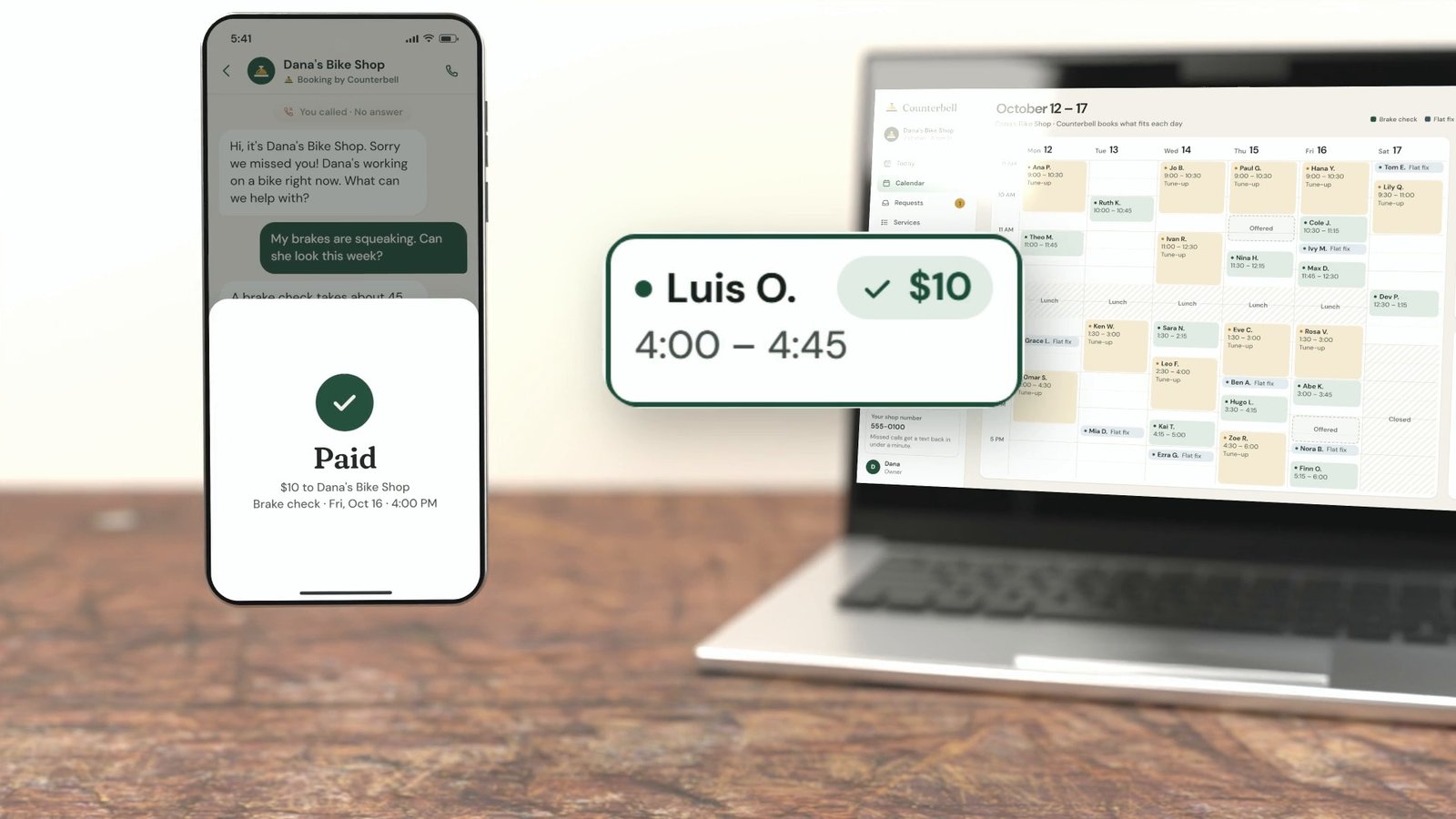
The whole piece lives in one Blender scene: one phone, one laptop, one brass bell, one wooden bench, one set of lights and materials; night is the same scene with the window off. 11 of the 22 shots, 50 of the 94 seconds, are rendered there. The bell was modelled from the logo's own proportions, so at the cut the 3D bell and the 2D mark stand in the same place at the same size.


Light the interface inside the screen.
The recorded interface goes into each screen in linear light, frame by frame, at the corners Blender projects for that frame, so the text keeps the sharpness of the recording and changes on the frame where the voice names it. A card that leaves a screen starts at its own element's corners: the booking that flies to the calendar is the real calendar block, 560 px wide in mid-flight.
Draw the other shops.
For the barber and the physio, the piece turns into a line drawing in the brand's green on its paper: three shop fronts, each with its bell. The service card fades into the real services screen and the odd request into the real "Ask Dana" inbox, and the drawing's paper is the interface's own colour, so the cut keeps its temperature.
Hang every cut and every sound on its word.
The edit is a plan: every cut lands two frames before its word, every title enters on its word, and every sound effect is a short window of its file inside the image that justifies it. 29 effects in the 16:9 and 11 in the vertical cut, with 0.0 s of effect over any other image.
Look at every frame.
Twelve-frame strips at every cut, title and caption, and close-ups at three times the size of every piece of interface text. Three rounds of fixes, each one made in the plan and rendered again from it. In the second, the camera pushed in on the reschedule and the payment (message text from 23 to 34 px), and the 2D mark held exactly where the 3D bell stood through the dissolve.
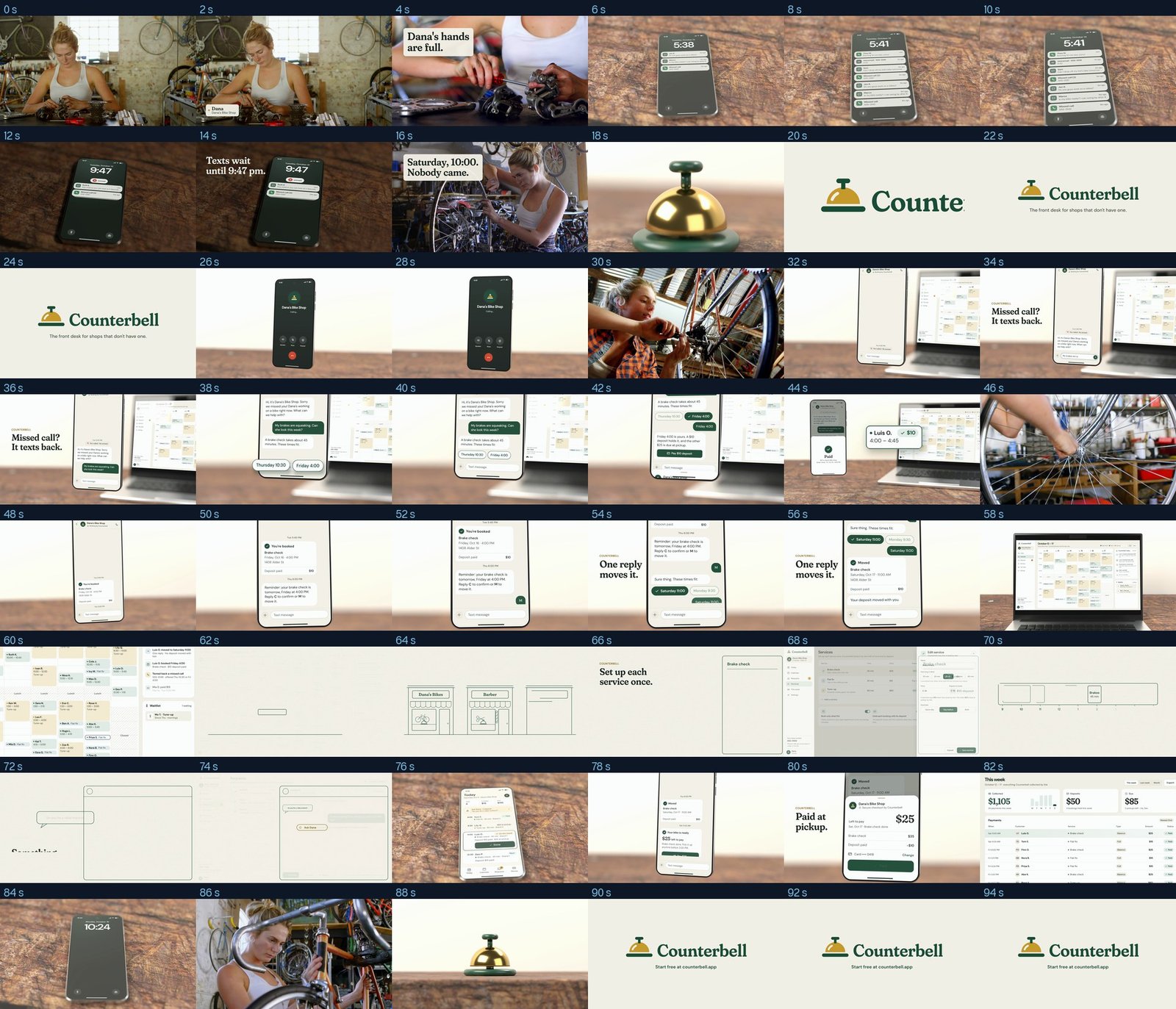
CONTACT SHEET · 48 FRAMES · ONE EVERY 2 S · SCROLL
Final and variants
| File | What | Size | fps | Length | Audio |
|---|---|---|---|---|---|
| counterbell-launch-16x9.mp4 | the launch video | 1920×1080 | 24 | 94.13 s | AAC 48 kHz stereo |
| counterbell-launch-9x16.mp4 | the vertical cut, the app inside the phone, burned-in captions | 1080×1920 | 24 | 29.42 s | AAC 48 kHz stereo |
| counterbell-logo.mp4 | the animated logo on the brand's paper | 1920×1080 | 30 | 4.00 s | AAC 48 kHz stereo |
| counterbell-logo-alpha.mov | the same logo with alpha, for editing apps (ProRes 4444) | 1920×1080 | 30 | 4.00 s | PCM 24-bit |
| counterbell-logo-alpha.webm | the same logo with alpha, for the browser (VP9) | 1920×1080 | 30 | 4.00 s | 48 kHz stereo |
| counterbell-template-*.mp4 | three templates (a feature, a figure or a quote, now available), each rendered with two contents: six files | 1080×1350 | 30 | 6 to 8 s | AAC 48 kHz stereo |
| counterbell-launch-16x9_*.wav | stems: voice, music, interface effects, music and effects, and the mix | 48 kHz, 24-bit | 94.14 s each | stereo | |
| counterbell-launch-16x9.srt and .vtt | captions timed to the spoken words | ||||
| counterbell-launch-16x9-cover.jpg and -9x16-cover.jpg | a cover frame for each video |
The MP4s are H.264 High, yuv420p, BT.709, with the index at the front for instant playback. The templates are 4:5, the feed format for LinkedIn and Instagram alike; each one reads its content from a small data file, so a new announcement is a new file.

Numbers
Measured on the delivered files.
| check | 16:9 | 9:16 |
|---|---|---|
| loudness (target −14 LUFS ±1) | −13.9 LUFS | −13.9 LUFS |
| true peak (max −1 dBTP) | −1.3 dBTP | −1.4 dBTP |
| voice over music, while speaking | +9.8 LU | +9.7 LU |
| sound effects outside their image | 0.0 s, 29 effects | 0.0 s, 11 effects |
| worst text contrast (min 4.5) | 5.25:1 | 11.0:1 |
| graphics inside the safe zone | n/a | yes, every frame |
| titles and captions, worst offset from their word | 1 frame | 1 frame |
| on-screen actions inside the sentence that names them | 28 of 28 | 11 of 11 |
| frames counted against length × fps | 2259 of 2259 | 706 of 706 |
| the voice, transcribed back against the script | 0.8% word error | 0.0% word error |
| people in frame, head and hands inside | 6 of 6 shots | 1 of 1 shot |
The launch, against the launches we measured before writing it: the first interface on screen at 4.6 s (product launches: 0 to 4 s; people-led ones: 18 to 21 s; this one opens on a person and her phone); interface on screen 59.5% of the video (46 to 67%); the product revealed at 18.2 s with the bell and the logo at 19.6 s (13 to 20 s); the end card 5.95 s, 4.8 s of it still; the image holds 1.2 s or more after 16 of 23 interface actions (median 1.94 s) and never under 0.6 s.
One world: the phone's glass bezel within ΔE2000 3.0 across every 3D shot of the same pose, and the brand's paper, green and brass on the end card within ΔE2000 0.7 of their tokens. The 3D wall measures at most 0.2 levels of fine noise and 1.1 of blotch, with frame-to-frame flicker of 0.8 levels at most.
Outside the references, by choice: the titles measure 5.7 to 6.7% of the frame height in capitals (the launches we measured: 9.7 to 14.5%), because they sit on the wall beside the device and leave the frame to the interface.
The stems line up with the mix to the sample; their sum differs from the mix by −19.4 dB, the master limiter's work. The six templates keep every element inside the canvas and every line of text at least 60 px from the edge, in one system of two typefaces and the brand's colours.
No views, clicks or conversions: the video has not run.
What we did
Script (on a research report on how product launches are built and paced), the product and its brand, the interface, direction, 3D, edit, motion, sound and the casting of the voice. The interface recordings, the 3D shots, the drawn interlude, the edit, the mix, the logo animation and the template kit were made in FireNgine, our production system, with the 3D rendered in Blender. The same app and the same phone return in a customer story, The Second Chair.
Provenance
Generated: the narrator's voice. The rest is licensed or made in FireNgine. The 3D was rendered in Blender.
Source files
Available on request: the edit as a timeline your own editor can open.
Have a script, a voice-overor a product to launch?
Send a short brief or write to us. We'll come back with questions, then one central idea for the piece before anything is made.
hello@firendev.com